Some words only make sense if you’ve spent time around porches, pickers, canning pots, and stories that run a little longer after dark. Hillbilly jam is one of those phrases. Depending on who’s saying it and where you heard it, it might mean a rough-and-rowdy music session, a homemade fruit preserve put up in Mason jars, or a whole attitude tied to Appalachian grit, humor, and make-do tradition.
That’s why the phrase sticks. It’s not polished, and it’s not supposed to be. Hillbilly jam carries the same kind of energy that built old-time string music, backwoods gatherings, county fairs, roadside fruit stands, and yes, the broader heritage culture that moonshine folks know by heart. If you’re trying to understand what people mean when they say it, you’ve got to look past the label and into the world it comes from.
Hillbilly jam has more than one meaning
In the most literal sense, some folks use hillbilly jam to describe a homemade jam with a rustic, country identity. It might be blackberry, peach, strawberry, mixed berry, or whatever was ripe, cheap, or growing wild that season. The point is less about a formal recipe and more about how it was made – by hand, in a real kitchen, often from family know-how instead of cookbook language.
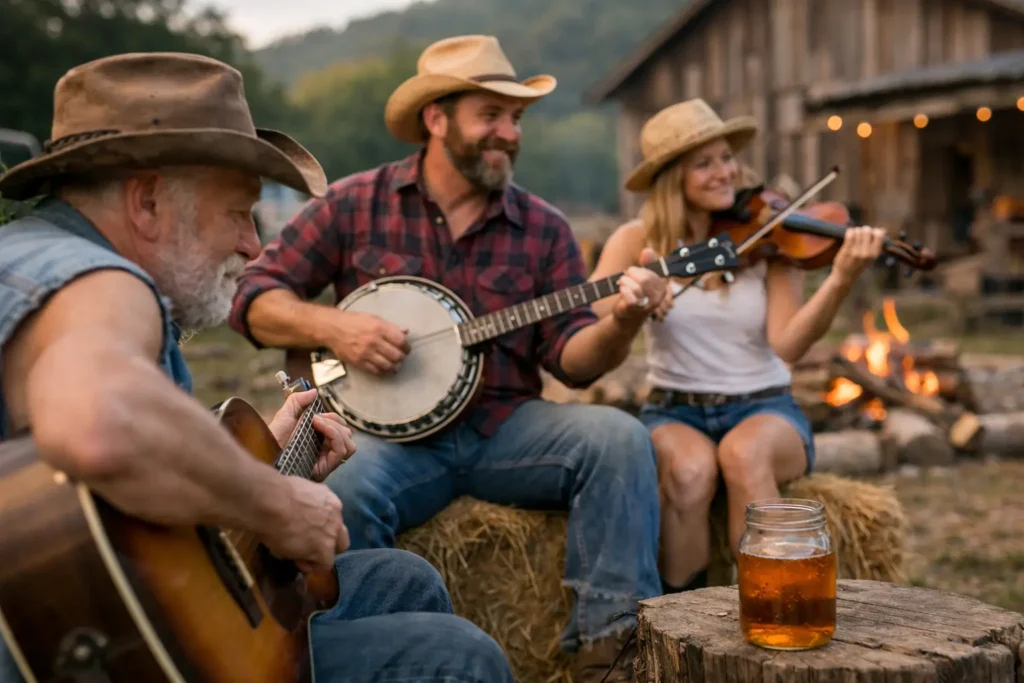
But in a lot of Southern and Appalachian circles, hillbilly jam also points to music. Think fiddles, banjos, flat-top guitars, upright bass, hand claps, and a room full of people who know three chords can carry a whole Saturday night. In that sense, a hillbilly jam is a picking session. It’s informal, loud in the right way, and built on participation more than performance.
Then there’s the broader cultural use. Sometimes people say hillbilly jam to describe a certain kind of event, brand, or aesthetic – country, scrappy, homemade, maybe a little rebellious, and proud of it. That use can be affectionate, but it can also get tricky. For some, “hillbilly” still feels tied to stereotypes outsiders put on mountain people without understanding their skill, discipline, or history.
That’s the trade-off with a phrase like this. It has charm and edge, but context matters.
The roots of hillbilly jam in mountain culture
If you want to understand why the phrase works at all, start with mountain life. In Appalachian and rural Southern communities, making do wasn’t a trend. It was survival, and it was pride. People canned what they grew. They played the instruments they had. They gathered where they could. Entertainment wasn’t something shipped in from somewhere else. It was made local.
That’s a big reason the phrase feels natural in backwoods culture. Jam, as food, came out of preservation. Jam, as music, came out of gathering. Both grew from the same basic truth – country people learned how to turn what they had into something worth sharing.
That overlap is part of what makes the term memorable. A jar of jam on a shelf and a jam session on a porch come from the same spirit. Homemade. Unfussy. Better when it’s shared.
People connected to moonshine culture usually recognize that right away. The old mountain traditions around distilling, music, food preservation, storytelling, and trading labor were never separate little boxes. They lived together. One family might have a still in the holler, a smokehouse out back, fruit jars cooling on a towel, and a fiddle tune drifting from the porch before supper.
Hillbilly jam as food
When people mean the edible kind, hillbilly jam usually signals a preserve that feels homemade and regional, not factory-made. You’ll hear it used for jams sold at flea markets, roadside stands, fall festivals, and craft fairs, especially when the branding leans rustic or playful.
There usually isn’t one official recipe, and that’s part of the charm. One version might be blackberry-heavy because the brambles were loaded that summer. Another might be peach with a little cinnamon. Somebody else might throw together strawberry and rhubarb and still call it hillbilly jam because the name says more about the spirit than the ingredient list.
That can be good for storytelling, but not always great for precision. If you’re buying it, selling it, or promoting it, the label draws attention, but people still want to know what’s in the jar. Flavor matters. So does whether it’s small-batch, low-sugar, cooked down the old way, or made with wild fruit. The name gets people to stop. The details are what earn repeat buyers.
That’s true across the whole heritage market. Folks love a colorful name, but they stay loyal when the product is real.
Hillbilly jam as music
On the music side, hillbilly jam usually points back to old-time, bluegrass, country, and mountain picking culture. Not a polished stage show. Not a choreographed production. More like a circle of players working through songs everybody halfway knows, then finding their way together.
The word “hillbilly” has a long history in early country music, and not all of it was respectful. The music industry used it for marketing long before many musicians had much control over how they were presented. Still, in some communities, the term got reclaimed with a grin and a little defiance. That’s common in rural culture. People take what was meant as a slight and wear it like a patch on a work jacket.
So when somebody says they’re heading to a hillbilly jam, they might mean an informal jam session with mountain music at the center. Fiddle tunes, gospel standards, train songs, drinking songs, heartbreak songs, and the kind of picking that can go from rough to brilliant in the same ten minutes.
That kind of gathering still matters because it keeps culture alive without turning it into a museum piece. It’s living tradition. Passed hand to hand, ear to ear.
Why the phrase still hits today
There’s a reason people still use hillbilly jam in product names, event titles, band promotions, and social media captions. It tells you something fast. It says this isn’t slick city branding. It’s rural, a little wild, and proud of where it comes from.
That said, not every audience hears it the same way. Some hear warmth, humor, and heritage. Others hear an old stereotype that flattens mountain people into a costume. If you’re using the phrase for a business, festival, food product, or media brand, it helps to know the difference.
The strongest brands in this world don’t just borrow the look of backwoods culture. They live it, respect it, and can back it up with real people, real stories, and real quality. That’s where a phrase like hillbilly jam either lands right or falls flat.
If it’s attached to something authentic, it feels earned. If it’s just slapped on for novelty, people can smell that a mile away.
Hillbilly jam and the moonshine crowd
This is where the phrase naturally crosses over into the heritage spirits world. The same audience that shows up for mountain music, roadside preserves, and country festivals often overlaps with the folks who follow moonshiners, legal distillers, and Appalachian makers. They’re drawn to stories of craft, hustle, family tradition, and doing things the hard way because that’s how they were learned.
That’s also why image matters. In this industry, names and nicknames can open the door, but the deeper connection comes from truth. A strong label, a sharp logo, a good bottle shot, or an event banner may get attention, but if the story behind it isn’t rooted in the culture, it won’t hold. That’s true whether you’re promoting jam, music, or white liquor. Authenticity still outruns polish.
Folks in this space know the difference between branding and bluffing. A name like hillbilly jam works best when it’s tied to a real place, real people, and something made with care.
So what should you picture when you hear hillbilly jam?
Picture a jar cooling on the counter while somebody tunes a banjo in the next room. Picture a church fundraiser, a mountain festival, a trading post shelf, or a front porch after supper. Picture laughter, hard work, local flavor, and the kind of culture that never needed permission to be itself.
Hillbilly jam isn’t one neat definition, and that’s probably the point. It’s a phrase with dirt under its nails. It belongs to food, music, memory, and identity all at once.
If you use it, use it honestly. If you sell it, make sure the goods match the label. And if you hear it out in the wild, don’t rush past it. There’s usually a deeper story sitting right behind the name, and that’s where the good stuff lives.


Comments are closed.