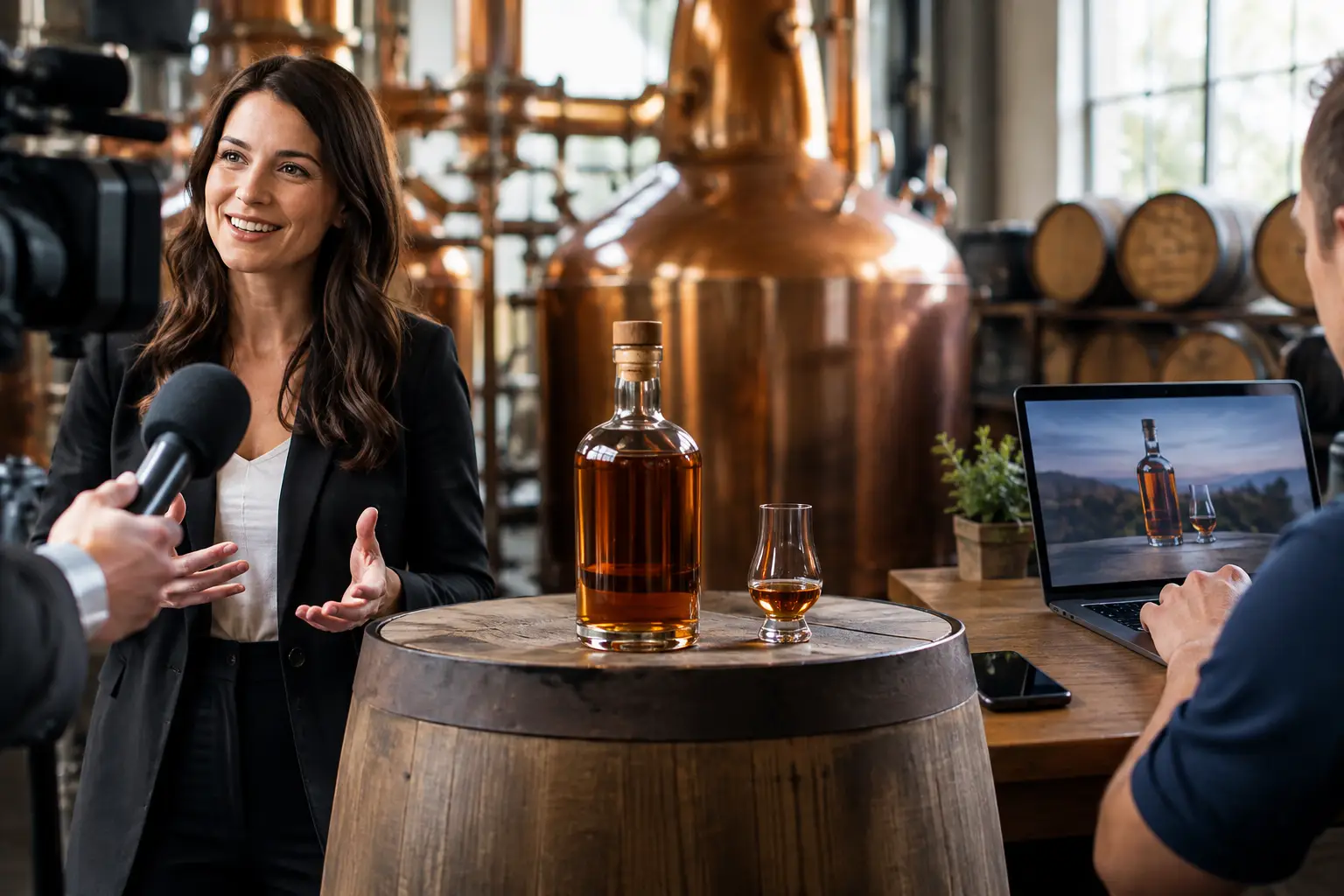
A new bottle label, a sharp logo, and a few boosted posts will not carry a distillery very far if nobody has a reason to care. That is where distillery PR versus advertising becomes a real business decision, not marketing talk. One earns attention through a story people want to repeat. The other pays to put a message in front of the right folks. Good spirits brands use both, but they do not use them for the same job.
For a heritage distillery, a legal moonshine outfit, or a backwoods brand with a real family story, the difference matters. You are not selling plain liquid in a plain package. You are selling the hands that made it, the place it came from, and the reason it belongs on somebody’s shelf or in their glass.
Distillery PR Versus Advertising: The Plain Difference
Advertising is paid placement. It can be a social media campaign, a streaming ad, a sponsored post, a print placement, a billboard near a tourist route, or a targeted campaign promoting a new release. You control the words, the timing, the visual, and usually the audience filters. If the budget is there, the message can move fast.
Public relations is earned attention and relationship-building. It includes a local news story about your grand opening, an interview with your head distiller, media coverage from a festival, a feature in a spirits publication, a podcast conversation, or a personality sharing the real story behind the bottle. You can pitch the story and provide photos, video, and facts, but you cannot buy credibility outright.
That is the part plenty of brands miss. An ad says, “We make great whiskey.” A respected outlet, trusted personality, or real customer story gives people a reason to believe it. PR carries the third-party trust that paid advertising often cannot.
Neither one is magic. A weak story will not become powerful because it got published, and a great story will not travel far if the brand has no plan to share it. The strongest work puts a real story in the ground first, then uses paid media to help it reach farther.
What PR Does Best for a Distillery
PR is made for the things that make your operation different. Maybe your family has been working the same land for generations. Maybe your corn comes from a neighboring farm. Maybe your recipe honors an old Appalachian tradition while meeting every legal standard. Maybe your founder has a larger-than-life personality and can tell a tale without sounding like a sales script.
Those details are not filler. They are the material that turns a bottle into a brand.
The Moonshiners television era helped prove that point to a national audience. Viewers did not keep tuning in just to see equipment and recipes. They came back for people like Tim Smith, Tickle, Mark and Digger, Amanda, Josh, Howard, and the rest of the characters who carried real place, humor, grit, and history into every episode. The shine mattered, but the story made folks care.
A distillery can use that same lesson without pretending to be something it is not. PR should put the genuine parts of the operation in front of the public: the grain sourcing, the local jobs, the restoration of an old building, the charity event, the founder’s heritage, the tasting-room experience, or the unusual release that has an honest reason for existing.
PR also has a longer shelf life. A strong feature, interview, event recap, or documentary-style video can be shared for months. It can live on your website, feed social media content, give your sales team talking points, and make a retailer feel more confident taking a chance on your product. That kind of attention builds reputation, not just impressions.
Still, PR takes patience. Editors and producers want a reason to cover you beyond “we have a new bottle.” They work on their schedule. A press pitch may get picked up next week, next season, or not at all. Brands that treat PR like a vending machine usually get frustrated fast.
When Advertising Earns Its Keep
Advertising is the workhorse when you need a clear action soon. If the tasting room has a Saturday concert, a bottle signing, a seasonal release, or a festival booth, a paid campaign can get that news in front of nearby adults who are likely to show up. You do not have to wait for a reporter to decide your event is newsworthy.
It is also useful when your brand has a proven offer. If a video of your distiller telling the family story gets strong organic engagement, putting money behind that video can extend its reach. If a tasting-room special consistently brings in visitors, targeted local ads can help keep the calendar full. Advertising gives you the ability to test creative, audiences, and timing with more control than PR ever will.
The trade-off is plain: people know it is an ad. They may watch it, click it, or scroll right past it. Paid reach disappears when the spend stops, and bad targeting can burn through money faster than a leaky condenser loses shine.
That does not mean advertising is a bad bet. It means the ad needs a real backbone. Generic photos of a bottle on a barrel with “premium craft spirits” slapped across the screen are easy to ignore. A short video of the maker, the still, the farm, or a packed event has more life in it. Show people what is real.
Use PR to Build Trust, Advertising to Create Motion
For most small and mid-sized distilleries, the best answer is not PR or advertising. It is a sequence.
Start by getting your house in order. Your website should make it easy to understand who you are, where to find you, what you make, and why your story matters. Your photography needs to look like your actual brand, not a stock image library. Your social channels should show consistent proof that the doors are open, the people are real, and the operation has something going on.
Then build a PR-worthy moment. That could be a new product with a meaningful local connection, a collaboration, an anniversary, an expansion, a community event, or an appearance by a personality with a genuine tie to the brand. Capture it right with professional photos, video, quotes, and a clear story angle. Give media and your own audience something worth passing around.
After that, advertising can amplify the momentum. Run paid campaigns around the event, the coverage, or the video that is already connecting. Retarget people who watched the video or visited the site. Invite them to the tasting room, the next release, or the next stop on the road. PR provides the proof. Advertising provides the push.
Moonshiner Gary has seen this work across the moonshine and heritage spirits community: a relationship opens the door, a strong story gets people talking, and consistent media work keeps a name from fading after the first splash. There is no substitute for being known by the right people for the right reasons.
The Budget Question: Where Should You Put Your Money?
If your distillery is new and your online presence is thin, do not throw every dollar into ads. First, invest in the assets that make every future promotion better: a solid website, brand photography, short-form video, clear product information, and a content plan built around your actual story. Sending paid traffic to a weak website is like inviting folks to the tasting room before you have swept the floor.
If the foundation is in place but you need bodies at an upcoming event, advertising may deserve the larger share for that season. If you are entering a new market, pitching retailers, or trying to establish long-term legitimacy, put more effort into PR, founder visibility, and media-ready storytelling.
The split depends on the goal. Need ticket sales by Friday? Advertising. Need a stronger name in your home region over the next year? PR. Need both? Build a campaign where one supports the other instead of making them fight for the same dollars.
Make the Story Worth Carrying
A distillery does not need a made-up outlaw tale or a Hollywood-sized budget to earn attention. It needs the confidence to tell its real story well, show the work behind the bottle, and stay visible after the launch-day noise dies down. Let advertising bring people to the gate, but give PR – and the people behind it – something honest enough to make them stay awhile.


Comments are closed.